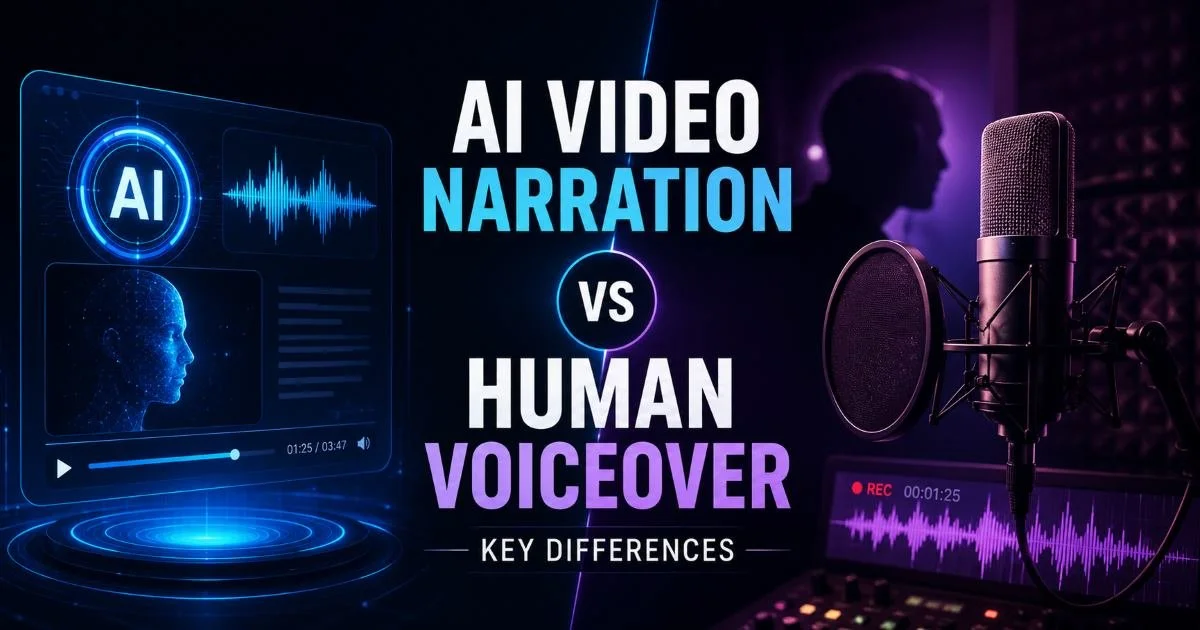
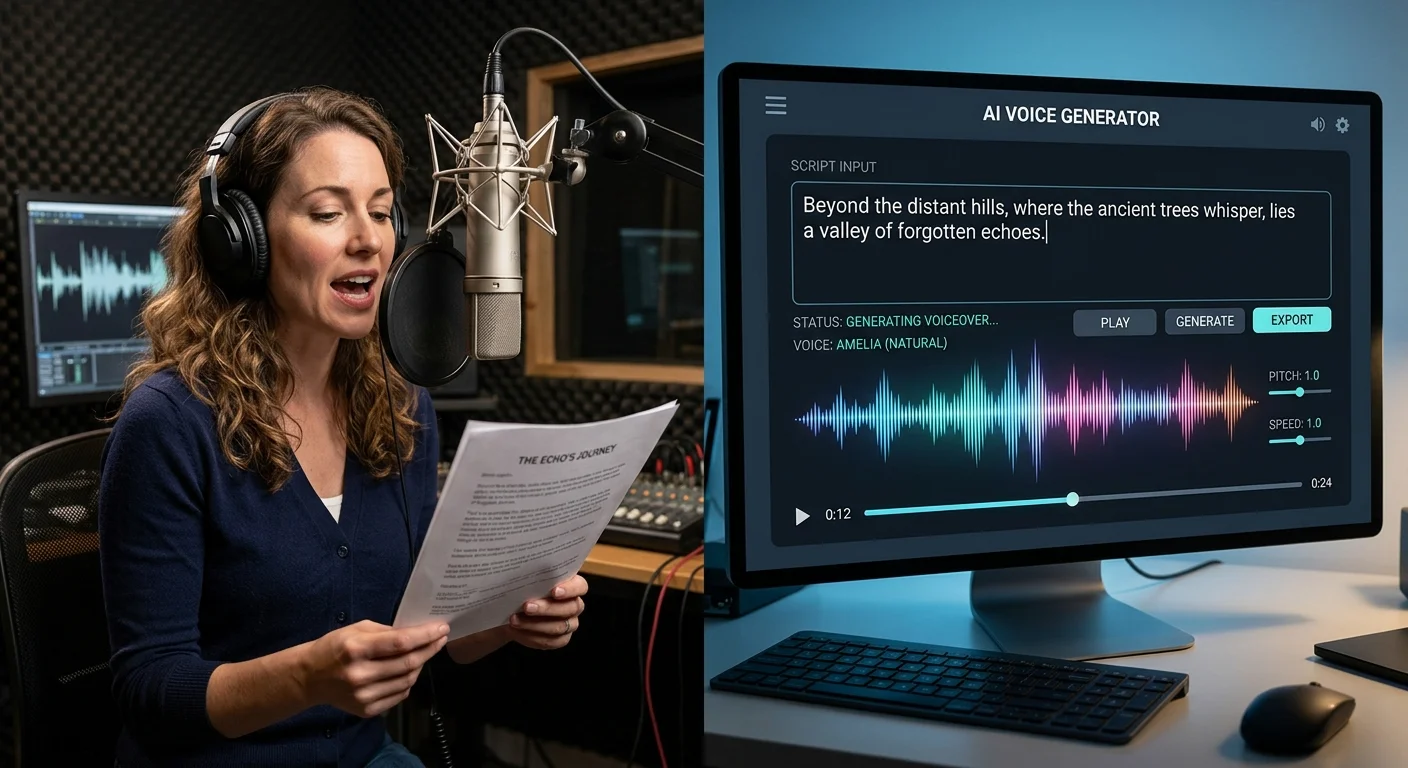
AI video narration tools have fundamentally changed how content creators approach voiceover work. What once required booking studio time, hiring talent, and managing multiple recording sessions can now happen in minutes with automatic video narration software.
But does faster always mean better? The answer depends on your project's goals, budget, and audience expectations. Human voiceover artists bring emotional depth, improvisation, and a personal touch that remains difficult to replicate. Meanwhile, AI voiceover generators deliver speed, consistency, and affordability that traditional workflows simply cannot match.
For a deeper understanding of how this technology works, explore what AI video narration is, its definition, examples, and mechanics. This comparison breaks down both approaches across the criteria that matter most to video editors and creators.
Key Takeaways
- AI narration generators produce voiceovers in minutes, while human recordings take hours or days.
- Human voiceover delivers superior emotional range for storytelling and brand-sensitive projects.
- AI video tools cost 80 to 95 percent less than hiring professional voice talent.
- Combining both approaches often yields the best results for serious content creators.
- Modern AI voices now pass listener tests at surprisingly high rates for informational content.
Cost and Speed
Production Timelines
Time is the most obvious dividing line between AI and human voiceover. A professional voice actor typically needs to receive the script, schedule a recording session, perform the read, and send files back for editing. Even with a responsive freelancer, that cycle takes one to three business days minimum. Rush jobs can trim the timeline, but they come with premium pricing that eats into already tight production budgets.
AI video narration software flips this equation entirely. You upload your video, the system analyzes the visual content, and you receive a narrated output within minutes. There is no scheduling, no back-and-forth communication, and no waiting. For creators who publish daily content on YouTube, TikTok, or internal training platforms, this speed advantage is enormous. If you want to compare specific platforms, check out this breakdown of top free AI video narration generators.
Budget Breakdown
Professional voiceover rates vary widely. A mid-tier English voice actor charges $250 to $500 for a five-minute video, while premium talent for commercial work can run $1,000 or more. These costs multiply when you need revisions, alternate takes, or multiple language versions. For a solo creator producing 20 videos per month, human voiceover can easily exceed $5,000 monthly before any editing costs.
Most AI voiceover tools operate on subscription models ranging from free tiers to $30 to $50 per month for professional plans. Even enterprise-level video narration software rarely exceeds $100 monthly. The math is straightforward: AI reduces voiceover costs by 80 to 95 percent for high-volume creators. That freed-up budget can go toward better cameras, editing software, or content promotion.
Start with AI narration for draft versions, then invest in human voiceover only for your highest-performing content.
Quality and Emotional Range
Where Humans Excel
No honest comparison can ignore the emotional superiority of skilled human voice actors. A trained performer reads subtext, adjusts pacing instinctively, and brings authentic feeling to a script. They know when to pause for dramatic effect, when to soften their tone for vulnerability, and when to punch a word for emphasis. These micro-decisions accumulate into a performance that listeners feel rather than simply hear.
Documentary narration, brand storytelling, and character-driven content all benefit enormously from human talent. Think about nature documentaries narrated by David Attenborough or the gravitas that Morgan Freeman brings to any voiceover. That kind of distinctive vocal identity creates audience loyalty. Brands investing in long-term voice consistency often hire a single actor across campaigns to build recognition and trust with their audience over time.
"The best voiceover work doesn't just inform the audience; it makes them feel something they weren't expecting."
Where AI Surprises
Modern AI voices have improved dramatically since the robotic text-to-speech engines of five years ago. Today's neural voice models produce natural-sounding speech with appropriate intonation, breathing patterns, and even subtle emotional inflection. In blind listening tests, audiences correctly identified AI-generated speech only 55 to 60 percent of the time for informational content. That gap narrows further every year as the underlying models advance.
For informational, instructional, and news-style videos, AI narration now meets professional quality thresholds. Understanding how AI voice cloning works in video narration tools reveals why these voices sound increasingly lifelike. The technology analyzes thousands of hours of human speech to replicate cadence, rhythm, and tonal variety. It is not perfect for every use case, but for the vast majority of YouTube explainers, product demos, and tutorial content, AI voices perform remarkably well.
AI voices still struggle with sarcasm, irony, and culturally specific humor. Review these sections manually before publishing.
Scalability and Flexibility
Multilingual and Bulk Production
Scalability is where AI narration generators pull decisively ahead. Consider a SaaS company that needs product walkthrough videos in 12 languages. Hiring native-speaking voice actors for each language means managing 12 separate talent relationships, scheduling 12 recording sessions, and coordinating quality across all of them. The project management overhead alone can consume weeks. With AI video tools, you select a language, choose a voice profile, and generate the narration almost instantly.
Bulk content production follows the same pattern. E-learning companies that produce hundreds of training modules per quarter find human voiceover pipelines bottleneck their entire workflow. AI eliminates that constraint entirely. Some platforms reviewed among the best AI voiceover tools for YouTube videos now support over 50 languages with multiple voice options per language. That kind of coverage simply is not practical with human talent at most budget levels.
Revision Workflows
Revisions expose another practical gap between the two approaches. When a human voice actor records a five-minute script and the client changes two sentences, the actor must re-record those sections, match the original tone and energy level, and deliver new files. If days have passed, matching the exact vocal quality can be difficult. Some actors charge per revision, and multiple rounds of changes can double or triple the original project cost.
AI narration handles revisions effortlessly. Change a word, a sentence, or an entire paragraph, and regenerate the audio in seconds. The voice remains perfectly consistent because the same model produces every take. For content creators who iterate rapidly, test different scripts, or publish time-sensitive material that requires frequent updates, this advantage is worth the tradeoff in emotional depth. Speed of iteration directly correlates with content quality when you can test and refine without financial penalty.
Use A/B testing with different AI voice styles to find which tone drives higher audience retention on your videos.
| Criteria | AI Narration | Human Voiceover | Winner |
|---|---|---|---|
| Cost per video | $0.10 to $2.00 | $50 to $500+ | AI |
| Turnaround time | Under 5 minutes | 1 to 5 days | AI |
| Emotional depth | Moderate | Excellent | Human |
| Scalability | Unlimited | Limited by talent | AI |
| Brand distinctiveness | Growing options | Unique identity | Human |
| Revision flexibility | Instant, free | Costly, slower | AI |
| Audience trust (premium) | Moderate | High | Human |
Best Use Cases for Each Approach
When to Choose AI
AI video narration generators make the most sense for high-volume, informational, and time-sensitive content. YouTube explainer channels that publish three to five videos weekly, corporate training teams building onboarding libraries, and social media managers repurposing long-form content into clips all benefit from AI. The economics simply work better when you need dozens of narrated videos per month without a proportional increase in spending. Tools like Video Narrator demonstrate how AI can watch your video content and generate contextually appropriate narration automatically.
AI also excels in prototyping and pre-production. Before committing to expensive human talent, creators can use AI-generated narration to test script timing, pacing, and audience response. This "draft narration" approach lets you refine your video before investing in the final voiceover. It is a workflow that saves money and produces better end results because the human actor receives a polished, tested script rather than a first draft. The growing capabilities of AI models, including those explored in this analysis of the best LLMs for video generation, continue expanding what automated narration can accomplish.
When to Choose Human
Human voiceover remains the right choice for high-stakes, emotionally driven, or brand-defining content. Television commercials, feature documentary narration, audiobook production, and flagship brand videos all demand the nuance that only a skilled performer delivers. If your video needs to make someone laugh, cry, or feel deeply connected to a story, invest in human talent. The ROI on emotional connection justifies the higher cost for content with a long shelf life.
Podcasts and serialized video content also benefit from human narration because audiences form parasocial relationships with consistent voices over time. That familiarity builds loyalty in a way that AI voices, despite their improving quality, have not yet replicated. When your voice becomes part of your brand identity, the personal touch of a human narrator transforms from a nice-to-have into a strategic asset. The key is matching the approach to the content's purpose, audience, and expected lifespan.
Avoid using AI narration for sensitive topics like healthcare, legal guidance, or crisis communication where audience trust in authenticity is paramount.
Frequently Asked Questions
?How do I start using AI narration without ditching human voiceover?
?Is AI voiceover actually cheaper than hiring a mid-tier voice actor?
?Can AI narration handle multilingual videos as well as human talent?
?Does faster AI turnaround mean lower quality for storytelling videos?
Final Thoughts
The choice between AI video narration and human voiceover is not binary for most creators. AI generators win decisively on cost, speed, scalability, and revision flexibility. Human talent wins on emotional range, brand distinctiveness, and audience trust for premium content.
The smartest content creators are already using both: AI narration for high-volume and iterative work, human voiceover for their most important pieces. Match your approach to each project's specific needs, and you will get the best of both worlds without overspending or underdelivering.
Disclaimer: Portions of this content may have been generated using AI tools to enhance clarity and brevity. While reviewed by a human, independent verification is encouraged.